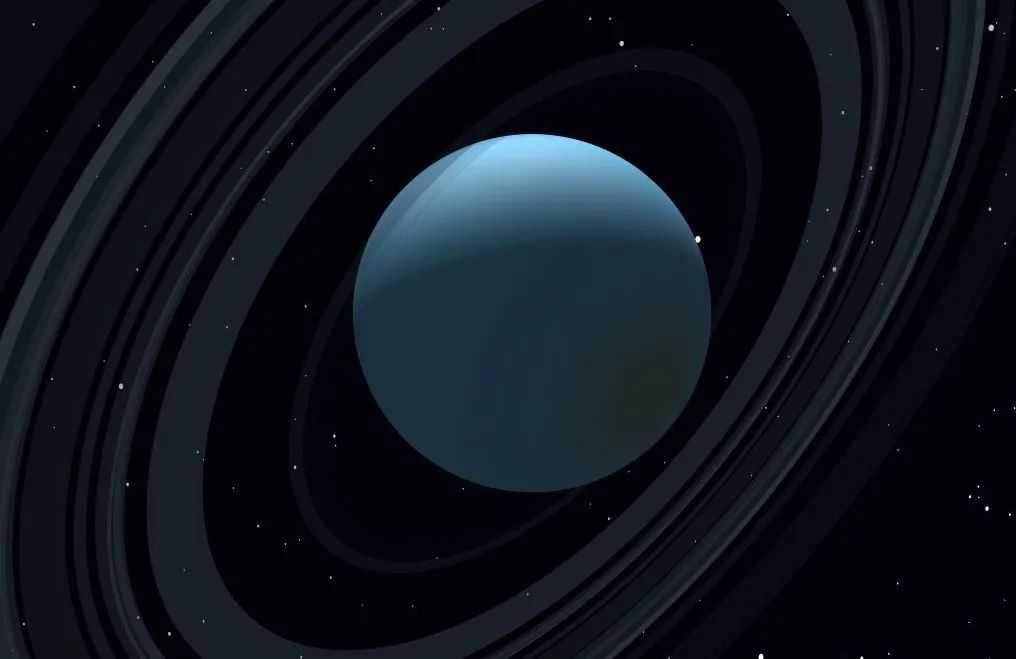
The planet’s atmosphere is primarily composed of hydrogen (83%) and helium (15%), with the remaining 2% consisting of "ices"—complex mixtures of water, ammonia, and methane. These icy compounds give Uranus its serene, pastel blue color: methane in the upper atmosphere absorbs red light, reflecting blue wavelengths back into space. Below the atmosphere lies a thick mantle of superheated, high-pressure icy fluids, which transitions into a small rocky core at the planet’s center. This structure classifies Uranus as an "ice giant," a category distinct from the gas giants Jupiter and Saturn.
Uranus’s unique tilt creates extreme seasonal variations, with each pole experiencing 42 years of continuous sunlight followed by 42 years of darkness. The planet has a faint ring system, discovered in 1977, consisting of narrow, dark rings made of dust and small rocks, and 27 known moons, most of which are named after characters from Shakespearean plays and Alexander Pope’s poetry. The largest moons, such as Titania and Oberon, are icy bodies with rugged terrains, including canyons and impact craters. While Uranus has been visited by only one spacecraft, Voyager 2 in 1986, ongoing observations by telescopes like the Hubble Space Telescope continue to reveal details about its atmospheric dynamics and magnetic field, which is offset from its rotational axis—a feature that adds to the planet’s enigmatic nature. As a distant sentinel of the outer solar system, Uranus remains a testament to the solar system’s diversity and the mysteries that still await discovery.